
.png)
Jean Pierre Wimille: gentleman pilot

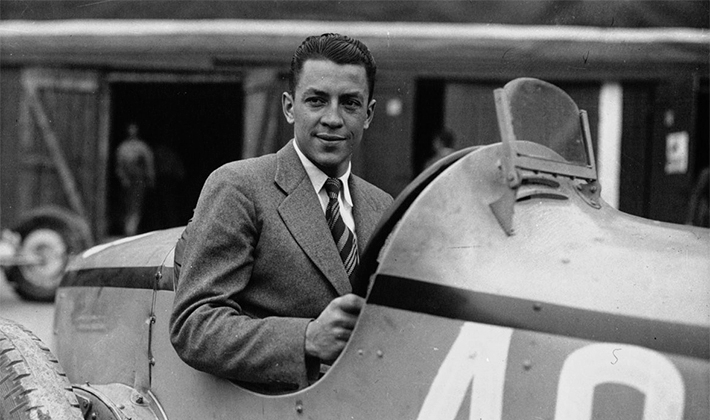
Jean-Pierre Wimille was born on February 26, 1908, in Paris. He was close to cars thanks to his father, Auguste, who was an automotive correspondent for the newspaper Le Petit Parisien and later for the New York Herald. He got his first car at the age of twenty, a Morgan tricycle, which he quickly wrecked and which was then replaced by a 1.5-liter Bugatti Type 37A.
Jean-Pierre began racing at the highest level in 1930.
Jean-Pierre Wimille's First Rides
In 1930, Jean-Pierre Wimille had enough money to buy his dream car—what else but the best in the business: a Bugatti. Since 1925, Bugatti had become the leader in the world of Grand Prix racing, with their innovative, striking, and easy-to-maintain Type 35 achieving record-breaking success in hundreds and hundreds of events. Part of their success stemmed from the numerous design variations available for drivers of all skill levels, ranging from an entry-level 1500cc car to a top-of-the-line supercharged racing machine. Wimille bought a 1500cc variant called the Type 37A, the least powerful in the Bugatti range, but at least he now had a car.
Wimille almost immediately entered the big leagues with this new car, competing in that year's French Grand Prix at Pau. This was no ordinary French Grand Prix; in 1930, the Automobile Club de France had abandoned the highly unpopular "fuel consumption" formula in use that year and replaced it with Formula Libre, which meant "Free Formula" in French. In practice, anything went, and interest in the Grand Prix exploded—an opportunity Wimille was quick to seize.
A multitude of Bugatti owners comprised the 25 entrants for the race, and Jean-Pierre Wimille set out to show the world that he could stand out among the sea of contenders. His race ended in disaster, as after only three laps, Wimille's small supercharger collapsed into the ground. He still managed to make his mark, however, with a fantastic first lap that saw him overtake several cars, proving to the huge crowd that he was fast. Wimille's short but effective outing managed to attract attention, especially from those with closer ties to the Bugatti organization than he himself.
At this point, I could go on praising Jean-Pierre Wimille as the perfect generational talent from the moment he got behind the wheel of a racing car and as someone who was always a prodigy. However, to be perfectly honest, at least in 1931, this simply wasn't true. While Wimille continued to compete in smaller events with his underpowered Type 37, he longed to participate more in international Grand Prix races with a more powerful car.
In the 1932 season, Wimille began modestly, participating in a few hill climbs, primarily short timed rallies on a mountainside where the entry barrier was much lower than on a circuit. Jean-Pierre put his new car to good use in March, and at one of France's most revered hill climbs, the classic "La Turbie," he took a convincing victory, finally establishing himself as a mainstay of European racing.
These First Victories in Algeria
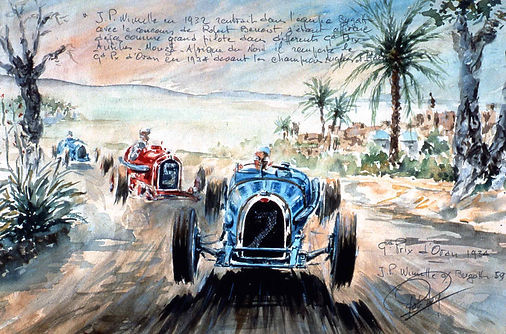
His good fortune continued to mount, as he secured his first circuit victory in Algeria a month later, at the 1932 Oran Grand Prix, confirming his talent on pre-war Algerian circuits and beating several of the best gentleman drivers, such as Marcel Lehoux and Goffredo Zehender. This string of successes ended after the engine of Wimille's car failed in Casablanca, rendering the Type 51 unroadworthy. He made his mark on Algerian motorsport history by also winning the 1934 Algerian Grand Prix in a Bugatti T59 at Bouzaréah.
From Bugatti to Alfa Romeo
Eager to move beyond Bugatti’s sphere of influence after 10 years of loyalty, Wimille bought a brand-new Monza-spec Alfa Romeo 8C-2300, their flagship all-around racing supercar of the time. With this new weapon, Wimille took the win at Nancy and entered the French Grand Prix for the European Championship, where he finished 6th before his mechanics miscalculated the fuel (talk about a ridiculous way to lose!). But at the Comminges Grand Prix in August, Wimille’s worst tendencies came back to haunt him, as he crashed on the slippery roads on the final lap of the race, negating what could have been a sure victory.

He was joined in the accidents by René Dreyfus, a star French racing driver who became a good friend of Wimille's. According to Joe Saward, legend has it that after they both lost the race, Wimille proclaimed to Dreyfus in their shared hospital room that he would become a politician at the end of his racing career. When Dreyfus asked him how he would get support, Wimille replied, "Women will vote for me!"

Jean-Pierre Wimille and Enzo Ferrari
In 1938, Wimille joined Enzo Ferrari's team to drive Alfa Romeos. At that time, Enzo was managing the official team of the Milanese marque. However, the dominance of the German Silver Arrows (Mercedes and Auto Union) limited their success during this period.
Then came the star driver of the Alfa Romeo factory team (now separate from Scuderia Ferrari). He dominated the Grands Prix of 1947 and 1948, regularly beating the new cars built by Enzo under his own brand, Ferrari, officially launched in 1947.

Enzo Ferrari would say that "Wimille certainly stands alongside Maurice Trintignant and Jean Behra as one of the greatest drivers representing France."
Wimille's time at Alfa Romeo was ultimately short, but quite productive, securing a podium finish against Mercedes-Benz at the Coppa Ciano and a 7th place at the Swiss Grand Prix. Unfortunately, at the beginning of 1939, Enzo Ferrari resigned after a falling out with Alfa Romeo's management, leaving Jean-Pierre Wimille without any major allies within the team. To make matters worse, even the Italians were beginning to tire of German dominance and sought isolation with a completely different set of regulations for Italian races. A much more "nationalistic" Alfa Romeo thus ousted the Frenchman Wimille, leaving him no choice but to return to Bugatti and race exclusively in his native country.

Wimille and the 24 Hours of Le Mans
Jean-Pierre Wimille is a true legend of the 24 Hours of Le Mans, with an exceptional win-to-participation ratio. He has started the race six times and won it twice.

Here are the highlights of his history at Le Mans:
1. His two historic victories
1937: He won with Robert Benoist in a Bugatti Type 57G "Tank." They shattered the distance record, covering 3,287 km.
1939: He won again with Pierre Veyron (who gave his name to the modern Bugatti) in a Bugatti Type 57C "Tank." This was the last edition before World War II.
2. The "Tank" style
Wimille is inextricably linked to the aerodynamic Bugattis known as "Tanks" because of their wraparound bodywork that covered the wheels—a revolution at the time that allowed them to reach impressive top speeds on the Mulsanne Straight.
3. His other participations
1931: His first time, in a Bugatti Type 50 (DNF).
1932: Driving an Alfa Romeo 8C 2300 with Raymond Sommer (retired while leading).
1933: Still driving an Alfa Romeo (retired).
1934: Back with Bugatti in the Type 44 (retired).

Wimille and Bugatti returned to the 24 Hours of Le Mans in 1939, using a modified version of the "tanks" they had used in 1937. This time, Wimille's teammate would be small-car specialist Pierre Veyron (after whom the Bugatti Veyron is named). Facing stiff competition from Talbot, Alfa Romeo, and Lagonda, Wimille and Veyron maintained a competitive pace, but their lead was only secured late in the race after Raymond Sommer's Alfa Romeo retired with engine trouble. Wimille and Veyron brought the car home after 24 hours with a comfortable lead over the V12 Lagondas, giving Bugatti their second Le Mans victory.

Jean-Pierre Wimille finished the season as the pride of France, and to this day he stands alongside Woolf Barnato and Fernando Alonso as the only drivers to have a 100% win rate at the 24 Hours of Le Mans on more than one attempt. However, the victory at the 20 Hours of Le Mans was Wimille's last successful race of 1939. He might have achieved more in 1940, but war broke out in Europe just three months after Le Mans. This was a real disaster for Wimille's ambitions.

Wimille during the Second World War
At the beginning of the German occupation of France in 1940, following the signing of the armistice, Wimille joined the "Cheasnut" resistance network, affiliated with the SOE (Special Operations Executive), the British secret service created by Winston Churchill to support the various Resistance movements in Europe. The Cheasnut network was unique in that it was led by three racing drivers: in addition to Wimille, there was his Le Mans teammate Robert Benoist, as well as William Grover-Williams, who was none other than the first winner of the Monaco Grand Prix! The network organized sabotage operations and recovered equipment parachuted in by the RAF, but it was dismantled by the Gestapo. Only Wimille survived: Grover-Williams was executed at the Sachsenhausen concentration camp in 1945, and Robert Benoist suffered the same fate at the Buchenwald concentration camp in 1944. Wimille was fortunate enough to escape capture and spent the rest of the war continuing Benoist's work in Paris, coordinating attacks against the Germans in the weeks leading up to the liberation.
Once Paris was liberated, he joined the Free French Air Force and spent the final days of the war flying missions over Germany.
Wilmie's vision for the automobile of the future
During the war, in addition to his resistance activities, Jean Pierre reflected on the vehicle of the future and designed a fully enclosed vehicle with a panoramic windshield and an electrically controlled gearbox, revolutionizing the established norms of century-old manufacturers. The vehicle boasted a very low drag coefficient of 0.23 (few cars today have such a low aerodynamic drag coefficient). The driver sat in the middle with a passenger seat on either side, and in the center of the rear was a 56 hp, 1911 cc Citroën four-cylinder engine.
Everything moved very quickly for Wimille, who collaborated with coachbuilder Philippe Charbonneaux to design a second prototype, equipped with a Ford V8. The realization of this project would only come to fruition after the war, in 1946, with the first appearance of the Wimille 01 prototype.

At the end of hostilities, Jean-Pierre Wimille returned to the racing circuit with his usual success. He emerged victorious in the Prisoners' Cup at the wheel of a Bugatti Type 59 single-seater. Intrigued by this idea of a vehicle of the future, Maurice Dolfus, then CEO of Ford France, offered Wimille the resources to bring his project to fruition. The driver signed a contract with the brand on February 28, 1948. A "Special Cars" department was created by the Detroit-based manufacturer to produce Jean-Paul Wimille automobiles. The first model born from this collaboration was the JPW 01. For this vehicle, Wimille commissioned the Faget Farnet workshop for the bodywork and the young stylist Philippe Charbonneaux, who proposed a design that respected the vehicle's highly aerodynamic lines. The culmination of a project conceived during the war, this resolutely modern model with its futuristic lines was successfully presented at the 1948 Paris Motor Show. Three of the four prototypes built still exist.
After World War II
After the war, Wimille won the Prisoners' Cup in 1945, the first post-war race. It was organized in honor of Robert Benoist, through the Bois de Boulogne in Paris. Many competitors, including Wimille, ran in their wartime uniforms.

Racing did not immediately return to war-torn Europe. Although countries hoped to boost morale by organizing events, the priorities were food, health, and housing. However, some events did persist, and by 1946 it was possible to organize a small calendar of national and international races. Wimille joined the Alfa Romeo factory team, making his debut at the St. Cloud street race in 1946. A month later, at the Geneva Grand Prix, Wimille finished on the podium in the first postwar international race.
By 1947, Wimille was a sought-after driver, highly sought after by both Alfa Romeo and Gordini. An agreement was reached allowing the Frenchman to race for Gordini in French events, as well as for Alfa Romeo internationally. The season was mixed for both teams, although Wimille won the 1947 Robert Benoist Cup for Gordini, a fitting tribute to a French driver who owed so much to his teammate, a hero of the Resistance.
1948 was a good year for Wimille, in terms of racing. He dominated the European season for Alfa Romeo, winning the French, Italian, Monza, and Turin Grands Prix, and would have won the World Championship that year had the title existed at the time. In a true gentlemanly gesture, in 1948, as a tribute to Varzi, who had been killed in practice, he graciously conceded victory to Alfa's other Italian driver, Trossi, at the European Grand Prix in Bern. What's most exciting for F1 fans, however, is the description of the duel between Wimille and racing legend Juan Manuel Fangio at the 1948 Rosario Grand Prix.
The two men were in identical cars, so it was truly a duel between two drivers, nothing more. Wimille led the race from the start, but in a battle of tactics and willpower, the Argentinian gained the upper hand, eventually overtaking the Frenchman for the lead. But Wimille wasn't about to be beaten by the local hero, and he fought to get back in front of Fangio. Once he had the pass within reach, Wimille refused to give an inch, and Fangio retired due to engine failure. Had Wimille lived into the 1950s, he would have given Fangio a run for his money in the early years of the Formula 1 World Championship.
The fatal accident!
On January 28, 1949, while practicing for the Buenos Aires Grand Prix in a Simca-Gordini, Wimille lost control and crashed sideways into a tree in the Parque del Palermo area. The angle of the impact was completely against him, and he died instantly, just under a month before his 41st birthday. The cause was never officially determined.

Wimille's death was a huge shock to the racing world, as the Frenchman's skillful and refined driving style had served as a model for many of his peers. The great Fangio himself later acknowledged that Wimille had been one of his benchmarks.


Comments